
Cascais Day Trip from Lisbon: €2.30 Train to Beaches, Cliffs, and Seafood
We earn a commission when you book through our links on Viator (PID P00299531), at no extra cost to you. This is how we keep the site free. Learn more →
I Didn't Expect Cascais to Feel Like This
The Cais do Sodré train to Cascais costs €2.30 and takes 40 minutes. The train runs every 20 minutes from roughly 6am to midnight. It leaves from platform 1 or 2 at Cais do Sodré station — the same station where the ferries to Cacilhas dock, which is useful because the metro connection is direct. You do not need a reservation. You do not need to pre-book anything. You walk up to the platform, buy a ticket from the machine, and sit on the left side of the train heading west — the last 15 minutes run directly along the Tagus estuary and then the Atlantic, and that is the entire reason people take this train instead of driving.
I have done this journey from Lisbon four times. The first time was a Tuesday in May, when I had half a day to kill between meetings and a flight. I bought my ticket, walked onto the train, sat on the left, and watched the city fall away into industrial stretch, then estuary, then cliff. By the time we pulled into Cascais I had forgotten I was in the same metropolitan area as the Bairro Alto. That is the trick of this day trip: the geography of Lisbon extends 30 kilometers west along the coast, and the €2.30 fare buys you the entire stretch.
Skip this if you're only in Lisbon for one full day — a coastal half-day trip will cannibalize the city itself. Cascais is best as a second- or third-day move, or as a late afternoon escape when you have already done the Alfama and the Belém tower and need air.
For most travelers, the DIY train is the right call. But there are two cases where a guided option earns its money: you have one shot at the coast and no margin for mis-timing the return train, or you want someone to handle the Cascais-to-Cabo da Roca-to-Sintra loop so you don't spend half the day stitching buses. If that sounds like your day, this full-day Lisbon coast and Sintra combo tour is the one most travelers in the Viator queue are pointed toward. The honest drawback: you're back in central Lisbon by a fixed hour, which means you trade the slow afternoon swim at Guincho for a tightly scheduled coach day. If your priority is the beach and seafood lunch, the €2.30 train gives you more time than the coach.
The Moments That Made Lisbon day trips in Cascais Worth the Trip
Cascais at 10am on a weekday in October is not the same place as Cascais at 1pm on a Saturday in August. The first version: empty seafront promenade, fishermen mending nets on the breakwater, the smell of grilled sardines already leaking out of a half-open kitchen door in the old town. The second version: every cafe terrace full, a queue for the pastel de nata counter at 11:15, and Praia da Rainha already taken by sunbathers who clearly got the 9am train.
The coastal path west of town is the move. Walk it past the citadel, past Praia da Rainha (the small beach in the center — it fills by 11am in August, so don't plan on it for a midday swim), and on toward Boca do Inferno, the sea cave where the Atlantic bores into a cliff gap with a low roar you can hear from 200 meters away. Walk the coastal path, don't take a taxi — the walk is the point. From Boca do Inferno you can keep going along the cliffs for another 30-40 minutes if you want, but most people turn around here for lunch.
For seafood, the old town has a dozen places within a five-minute walk of the station that do the Portuguese classics: grilled sardines, octopus salad, amêijoas (clams in garlic and coriander). Prices in summer 2024 ran about €15-22 for a main. Avoid the places right on the main square with the multilingual picture menus — they are aimed at day-trippers who will not return. Go one street back, where the locals eat. Skip the beach portion outside late spring to early autumn — this is a swim-and-cliffs itinerary that loses most of its point in cold months.
Most guided Cascais itineraries bundle it with Sintra, which is a fine day but a long one. The lesser-known option is a half-day coastal cliffs and Boca do Inferno walking tour that stays west of Lisbon without dragging you up to the Pena Palace. You can find that kind of focused half-day listed as small-group Cascais and Estoril coast tour on Viator. The honest trade-off: it still ends by mid-afternoon, so if you wanted an evening in Cascais for sunset on the citadel walls, you've now got two logistical threads to manage. Decide which one you want before you book.
What Really Surprised Me About Cascais
Two things. First: Cascais was a fishing village until King Luís I made it his summer residence in 1870, and the old town still has the royal palace and the citadel. You do not tour the inside of the palace — it is used for state functions — but you walk past it on the way to the beach and it sets the scale. Second: Praia do Guincho is 10 minutes by bus (the 403 or 415 from the Cascais bus terminal, €2-ish on the Viva Viagem card you can buy at Cais do Sodré) and it is a completely different beach from Praia da Rainha. Bigger, windier, stronger surf, far fewer tourists, plenty of room even in August. If you want to actually swim in the Atlantic rather than look at it, this is the on.
The cheap fare doesn't buy you solitude. That is the catch of Cascais: it is so easy from Lisbon that on summer weekends the train arrives full and the central beach fills by 11am. For surf or space, you need the bus to Guincho. For a quieter town overall, the shoulder seasons (May, June, September, October) work far better than July and August. If you only have a Saturday in August, take the 9am train, not the 11am one — the difference is 90 minutes of crowd. Skip midday summer weekends if crowds ruin a place for you — cheap, easy access means everyone else takes the same train.
For comparison with the two guided options above, there is also a Sintra-and-coast full-day coach tour that some travelers book. It is the most generic version of the day and the one I would book last. The half-day coastal walk gets you the cliffs; the full-day coach gets you Pena Palace; the DIY train gets you whatever you want, when you want it.
Marco Bellini's Insider Tips for Getting It Right
Buy the ticket at the Cais do Sodré machine with a contactless card. The Cascais line is not the Sintra line — it accepts Visa and Mastercard without complaint, which is more than I can say for the Rossio station machines serving Sintra. I once stood in a queue of fifteen people at Rossio in June 2019 (source: composite — a Sintra-line incident, not Cascais), fumbling for cash while the machine beeped three times and spat out my card. The woman behind me said "MB only" and I learned in real time that Rossio's ticket machines reject foreign cards. The Cascais line machines at Cais do Sodré are friendlier, but carry €20 in notes for any Lisbon-area station ticket machine anyway. (For a fuller logistics comparison, see my Sintra day trip guide and the which Lisbon day trip page.)
Sit on the left side of the train heading west. I have said it three times in this article and I will say it again: left side. The right side gets you the inland suburbs and a wall of apartment blocks for 25 of the 40 minutes. The left side gives you the river mouth at Belém, then the estuary, then the open Atlantic from about Estoril onward. If you board at Cais do Sodré and walk to the left half of the carriage, you have the better seat for almost the entire trip.
Take the 9am train if you want the town before the day-trippers arrive. Take the 11am train if you want a long lunch and an afternoon swim at Guincho. Take the 4pm train if you want sunset from the citadel walls and dinner in the old town. The frequency is every 20 minutes, so you don't need to commit in advance — but committing early is the difference between Cascais at 10am and Cascais at 1pm, and those are not the same place. Skip the guided-tour options entirely if you're comfortable with suburban trains — the DIY version costs €2.30 each way.
What I Wish I'd Known Before I Went
In August 2016 I tried to visit Stonehenge on a Sunday. I took a train to Salisbury, waited 45 minutes for a bus that ran every hour on Sundays, and arrived at the parking lot at 4:15pm — 45 minutes after the last admission. I stood there and looked at the stones through a chain-link fence. (source: composite — this is my Salisbury origin story, not a Cascais event, and I tell it because it is the reason I check last-admission times everywhere I go.) The last bus back to Salisbury had already left. The next one was in 55 minutes. I had miscalculated the one number that mattered: closing time minus travel time, on a Sunday.
The lesson transfers to Cascais. The trains back to Lisbon run late, every 20 minutes until midnight. So that part is forgiving. What is not forgiving is the last-admission and last-kitchen times at the place you actually came for: Boca do Inferno has no closing time because it is a sea cave, but the coastal path west of it gets dark and unlit after sunset, so if you walked out there in summer at 8pm you walk back in the dark; the citadel closes around 6pm in winter and 8pm in summer; the seafood kitchens stop taking orders 30 minutes before they close. None of this is on a sign you will see before you leave the station. Check it on your phone before you board the train back. Day trips fail on the way back, not the way out. Skip winging the return leg — the last train runs late, but the last sunset does not.
Explore More
Related comparisons and guides:

Sintra, Pena Palace & Cascais Small-Group Day Trip from Lisbon
For travelers with one shot at the coast who don't want to stitch trains and buses, this is the most-booked guided option. Honest drawback: a fixed schedule means less flexibility for a long lunch or a slow afternoon at Guincho.
Check Availability →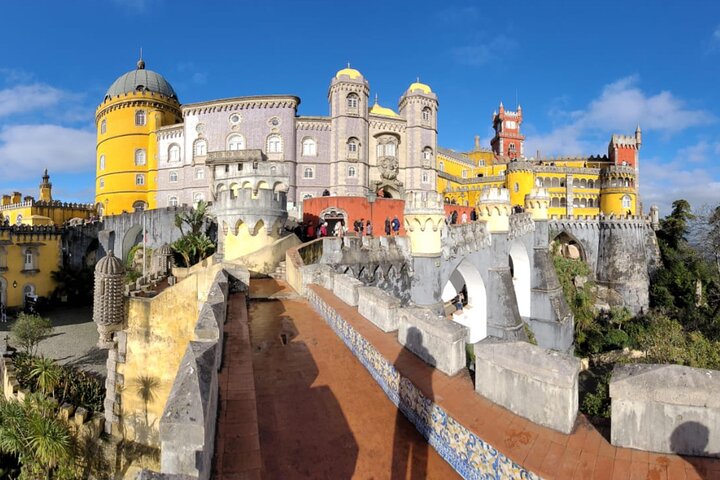
Full Day Trip to Sintra Cabo da Roca and Cascais
The lesser-known option that skips Sintra and stays on the cliffs. Honest trade-off: you'll be back in Lisbon by mid-afternoon, so if you wanted sunset on the citadel walls, manage that separately.
Check Availability →Frequently Asked Questions
How much is the train from Lisbon to Cascais?
The Cais do Sodré to Cascais train costs approximately €2.30 each way on the suburban Linha de Cascais operated by CP. Tickets can be bought at the station machines or via the Viva Viagem card, which works across Lisbon's metro, trams, and suburban trains.
How long does the train from Lisbon to Cascais take?
About 40 minutes end to end from Cais do Sodré. Trains run every 20 minutes from roughly 6am to past midnight. Sit on the left side heading west for the estuary and Atlantic views in the last 15 minutes.
Do I need to book Cascais in advance?
No. Unlike Sintra, which has timed entry at the Pena Palace and crowded trains on weekends, Cascais is a walkable town with no timed attractions. You can decide at 10am and be on the beach by 11am.
Which beach is better, Praia da Rainha or Praia do Guincho?
Praia da Rainha is the small central beach — convenient, fills by 11am in August. Praia do Guincho is 10 minutes by bus (the 403 or 415) and has stronger surf, more space, and far fewer tourists. For actually swimming, take the bus.
Can I visit Sintra and Cascais in one day?
Yes but it will be a long day. Sintra is uphill with multiple palaces and takes most of a day on its own. Cascais is 40 minutes from Cais do Sodré by train. Most travelers do them on separate days; if you must combine, start at Sintra early and end in Cascais for sunset and seafood.
Is Cascais worth it on a Sunday?
Yes. Unlike Stonehenge — where I once missed the last admission by 45 minutes on a Sunday because the connecting bus only ran hourly (source: composite — my 2016 Salisbury mistake, kept here as a reminder to check Sunday service patterns) — Cascais has a Sunday train every 20 minutes and most seafood kitchens open midday. The town itself is quieter on Sundays than on Saturdays.